Drupal Headless API Explained: What Agencies Should Know
A team is preparing one content backend for a web application, a mobile experience, and a commerce frontend. Drupal's API can serve those channels, but the hard decision isn't whether the endpoints work. It's who will own preview, cache invalidation, authentication, and incident response once the system is live.
For agencies and systems integrators, that distinction matters. A headless build can offer delivery flexibility, but it can also turn one content platform into two systems to operate. The practical question is whether Drupal's API benefits justify the ongoing work of maintaining the contract between the backend and every frontend that depends on it.
Table of Contents
- Why Teams Evaluate Drupal Headless
- What Drupal's Headless API Delivers
- Where Drupal Headless Gets Complicated
- Drupal Headless vs Managed Platform Alternatives
- When Drupal Headless Still Makes Sense
- Migration Paths Off Drupal Headless
- The Recommendation and Your Next Step
Why Teams Evaluate Drupal Headless
WebinOne's view is that Drupal headless should be evaluated as an operating model, not just an API choice. Drupal can make structured content available to multiple channels, but the organization still has to decide who keeps those channels reliable and consistent.
A typical evaluation starts with real pressures: a client wants to reuse content across a website and app, or an enterprise team wants to separate its editorial backend from a distinct digital experience. The agency may already know Drupal and have custom content models in place. That makes the API an attractive starting point, especially when teams want to preserve their existing editorial and governance setup.
The cost calculation changes when the frontend needs editorial preview, search visibility, metadata, language navigation, and fast updates after publication. In a fully decoupled setup, Drupal doesn't assemble the final experience. The frontend team must implement and maintain the parts of that experience previously handled in the CMS, while backend and frontend teams coordinate changes through a shared contract.
| Decision point | Drupal headless | Managed platform approach |
|---|---|---|
| Content delivery | Structured Drupal entities are exposed through an API | Content is managed in a platform that also offers headless delivery |
| Editorial preview | The frontend needs a defined preview workflow | Preview and publishing responsibilities depend on the platform's supported workflow |
| Cache freshness | Teams design invalidation across Drupal and frontend caches | Platform operations and frontend cache behavior still need clear ownership |
| Day-to-day operations | The organization plans backend and frontend support together | Platform operations can be handled as part of a managed service |
This isn't an argument against decoupling. It's an argument against approving a headless project because the endpoint demo worked. Before committing, the buyer should name the owner for preview fidelity, cache purging, access policy, and recovery when either system fails.
Practical rule: If no one owns the operational contract, the project has a gap, not an architecture.
What Drupal's Headless API Delivers
WebinOne recognizes that Drupal's JSON:API gives teams a substantive foundation for headless delivery. It turns Drupal's entity model into a standardized way to make content available to separate applications.
The standalone Drupal JSON:API project was created on May 11, 2016, and its functionality was later incorporated into Drupal core. Drupal describes the module as a compliant implementation of the JSON:API specification. It isn't enabled automatically, but it's distributed with supported core versions. Once enabled, it exposes Drupal entity types through a REST API, with resources organized around entities and bundles such as content types, media, users, and taxonomy terms. (Drupal JSON:API documentation)
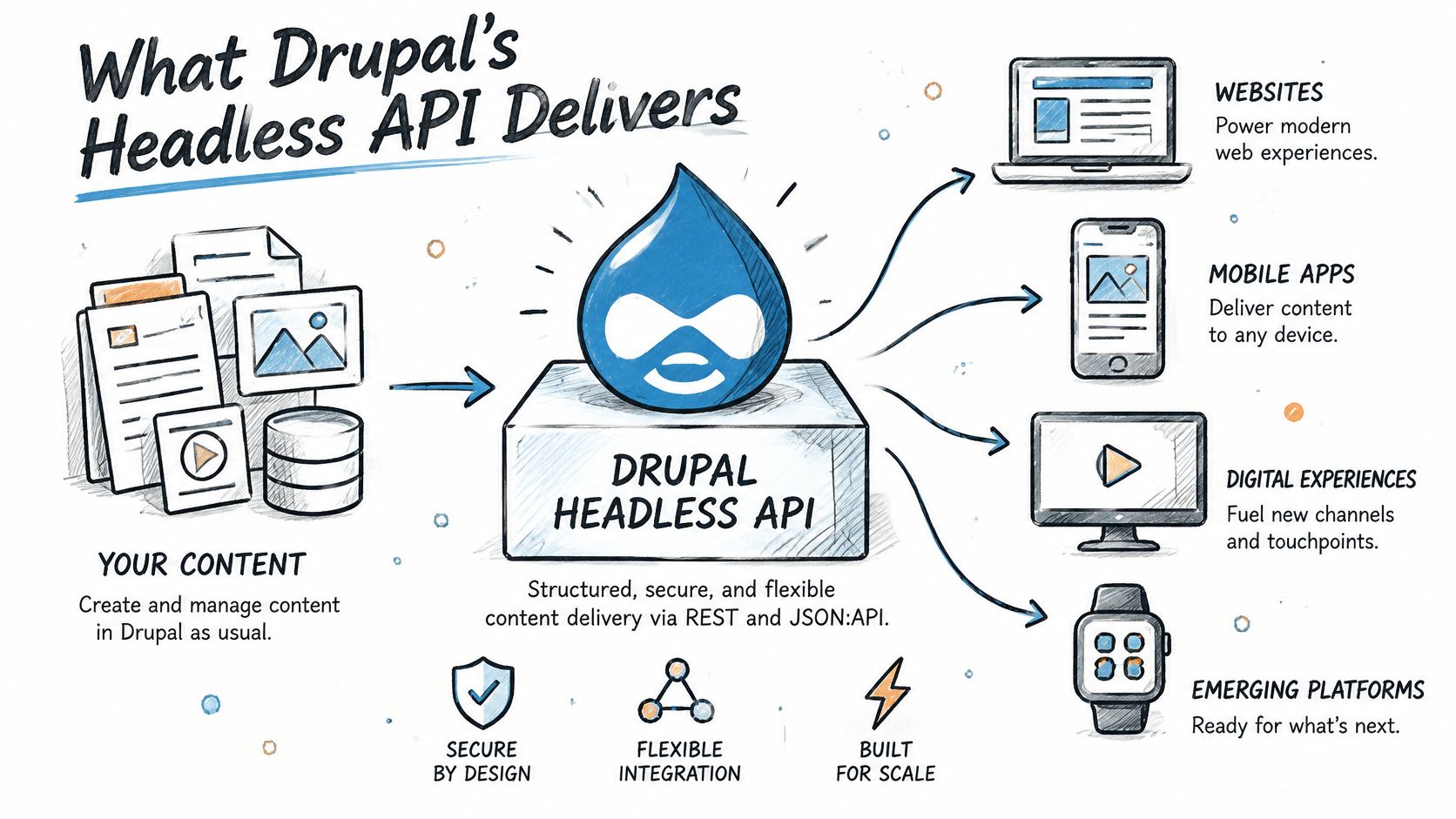
That resource model supports the standard HTTP methods GET, POST, PATCH, and DELETE, enabling applications to read, create, update, and delete structured content programmatically. A collection request such as GET /jsonapi/node/article can return multiple article resources. The broader JSON:API design includes conventions for relationships, filtering, sorting, and pagination, helping frontend teams work with predictable requests rather than creating a custom endpoint for every screen. (Drupal JSON:API architecture documentation)
For teams assessing how this separation works across a full system, Presidio's headless architecture guide offers useful context beyond the Drupal API itself. The key architectural benefit is reuse: Drupal can remain responsible for content modeling, editorial workflows, and permissions while different applications consume structured content. For a wider primer on how REST endpoints fit into application delivery, see WebinOne's guide to REST API endpoints.
The boundary is important, too. Drupal's core JSON:API is centered on Drupal entities. That's a strong fit for content delivery, but specialized business operations may need custom REST resources or other integration mechanisms. An API is a foundation, not a promise that every application requirement will be met by default.
Where Drupal Headless Gets Complicated
WebinOne's position is that fully headless isn't automatically the newest or least expensive choice. The operational workload moves; it doesn't disappear.
Start with cache behavior. Drupal's cache tags attach dependency information to cached data, so teams can invalidate content based on entities, lists, bundles, configuration, and other declared dependencies. That can support longer-lived proxy or application caches while keeping published changes fresh. But broad tags can trigger broad invalidation: the documented filtered-collection optimization addresses how a generic node_list tag can invalidate cached collections unnecessarily when any node changes. More precise tags can narrow which collections need purging. (JSON:API Filter Cache Tags project documentation)
That makes cache invalidation part of the API contract. The Drupal team needs to define what triggers invalidation, and the frontend or infrastructure owner needs to ensure the resulting pages and application data refresh as expected. Teams should test cache-hit ratio, p95 API latency, origin request rate, and invalidation fan-out under realistic publishing conditions. Those are operational checks, not promises of a particular performance outcome.
Authentication and exposure governance are another shared responsibility. Drupal REST configuration requires teams to grant permissions, select supported formats, and configure authentication for each resource. Non-read-only requests require an X-CSRF-Token header, so a frontend that creates or changes content must implement the configured protections instead of treating the API as an unrestricted JSON service. (Drupal REST configuration documentation)
Teams also need a deliberate policy for which fields, relationships, revisions, and unpublished states each audience can access. The implementation should account for role-based permissions, token scope, CORS, rate limiting, and monitoring for suspicious usage. The enterprise headless CMS discussion is relevant to this wider question of controlling API use across organizational needs.
The missing deliverable is an operational blueprint: API contracts, webhook behavior, cache purging, rollback procedures, ownership boundaries, and editor acceptance tests. Without it, an organization can replace CMS constraints with a two-system support burden and longer troubleshooting paths.
Drupal Headless vs Managed Platform Alternatives
WebinOne offers a managed platform option for teams that want headless delivery without making self-managed Drupal operations part of the ongoing engagement. The deciding factor is which responsibilities the organization wants to own, not whether Drupal can serve a frontend.
| Criterion | Drupal headless | Managed platform (WebinOne) |
|---|---|---|
| Authentication | REST resources require deliberate permission and authentication configuration | API access and integration responsibilities are defined within the platform's operating model |
| Content modeling | Drupal's entity and bundle model structures resources | Content is managed within a consolidated digital experience platform |
| Performance and caching | Teams design cache tags, invalidation, and frontend cache behavior | Hosting and platform operations are managed, while frontend cache behavior still needs an owner |
| Integration routes | JSON:API, configured REST resources, and custom integrations can serve the application | Headless delivery is available alongside APIs and webhooks |
| Operational burden | The organization plans core, module, hosting, security, and frontend support | Platform operations are handled as a managed service |
| Lifecycle management | Core and dependency changes require planning and testing | Platform maintenance is managed by the platform provider |
The comparison should include more than endpoint flexibility. It should ask who handles security updates, infrastructure, content preview, and support escalation, and whether the frontend team can make changes without breaking the API contract. For agencies, the answer affects the scope of a client project and the amount of ongoing operational work included in the relationship. A website design package comparison can help frame how delivery scope and ongoing responsibilities should be made clear to clients.
The decision isn't whether Drupal can power a headless frontend. It's who owns the operational contract between the platform and that frontend.
A managed approach doesn't remove the need to define frontend behavior or API access. It changes who carries platform operations. That distinction is useful for agencies that want to focus on client experiences, and for systems integrators deciding whether their engagement should include ongoing CMS infrastructure work.
When Drupal Headless Still Makes Sense
WebinOne's recommendation is not to replace Drupal just because a team has adopted headless delivery. Keeping Drupal can be reasonable when its editorial model and existing investment are central to the organization's work.
A team with deep Drupal expertise may be equipped to own upgrades, module maintenance, hosting, and API operations. The case is stronger when complex editorial workflows, Drupal permissions, or established content models would be expensive or disruptive to recreate. Organizations with existing Drupal investments should compare the total cost of continued operation with the cost and risk of migration, rather than treating the platform decision as a technical preference.
A fully decoupled architecture isn't the only way to separate parts of the experience. Progressive decoupling can preserve server-rendered pages and editorial preview while using JavaScript where specific interactions need it. That can keep more of the publishing experience in Drupal and avoid rebuilding every presentation responsibility in a separate frontend.
The decision should be tested against operational needs:
- Publishing workflow: Can editors review the actual experience before publication?
- Preview fidelity: Does preview reflect the frontend's rendering and content relationships?
- Cache strategy: Can the team explain how a published change reaches every channel?
- Ownership: Is there a named owner for API changes, frontend releases, and incidents?
- Channel demand: Does serving multiple applications justify the added coordination?
Compliance requirements also deserve a deployment-specific assessment. A self-managed architecture may be appropriate where an organization needs direct control over hosting and operations, provided the team can sustain that responsibility. Drupal's release schedule says Drupal 10 reaches end of life on December 9, 2026, which makes lifecycle planning part of any continuing Drupal decision. (Drupal core release schedule)
Migration Paths Off Drupal Headless
A migration off Drupal headless fails for operational reasons more often than data reasons. Content can usually be exported. The harder problem is moving the contract around it: who owns preview, how cache invalidation reaches the frontend, which service handles authentication, and who gets paged when publishing breaks.
Start by inventorying that contract, not just the database. Document content types, relationships, revisions, API consumers, authentication rules, cache dependencies, preview behavior, redirects, and publishing workflows. Put a named owner beside each area. If preview only works because one developer maintains a patched route, or cache purging depends on an undocumented cron job, that needs to surface before cutover.
Then separate required behavior from accumulated implementation. Custom modules and frontend logic often encode years of decisions. Preserve the business behavior editors and integrations depend on. Retire the rest. A staged plan can move content and functionality in defined groups, with validation before each release instead of one risky switch.
Testing has to cover both journeys. Editors should confirm content can be created, previewed, approved, and published with the fidelity they expect. Technical teams should verify permissions, integrations, URLs, metadata, cache behavior, and recovery procedures. A Drupal migration service overview can help scope whether that work stays in-house or moves to a managed migration.
Treat the project as a chance to simplify the operating model. Consolidate responsibilities, retire integrations that no longer earn their maintenance cost, and define who supports the platform after launch.
The Recommendation and Your Next Step
Keep Drupal headless when its editorial capabilities justify the operational work and your organization has named owners for the backend, the frontend, and the shared contract between them. If the team's real value is building client experiences rather than operating a content backend, evaluate a managed platform against the same contract: who owns preview, cache invalidation, authentication, and who gets paged when publishing breaks.
For agencies, that evaluation extends to the delivery model, white-label requirements, and how ongoing platform responsibilities fit the client relationship. The WebinOne reseller program lays out the partner model, so an agency can judge whether a managed platform belongs in its service portfolio.
For systems integrators, AWS partners, and enterprise teams, the next step is a conversation about migration or partnership requirements. WebinOne operates as a managed platform on AWS, and qualifying systems integrators can discuss licensed deployments in their own or a customer's AWS account by agreement, including AWS GovCloud. Start with a conversation with the WebinOne team about a partnership or migration.
The first deliverable worth producing is a responsibility map. Name the owners of preview, cache invalidation, authentication, release coordination, and incident response. If that map describes a workload your organization no longer wants to carry, bring it into the migration discussion as the scope, not as an afterthought.